Medical Advocates for Social Justice
Conference
Poster
|
Share this Poster with a Colleague Kaletra Library Service Home |
BACKGROUND
Lopinavir (LPV) is a novel HIV protease inhibitor (PI) that has shown significant antiviral activity and tolerability in clinical trials to date. LPV is co-formulated with ritonavir (RTV), an inhibitor of cytochrome P450 3A. It is highly sensitive to pharmacokinetic enhancement by RTV, resulting in substantially increased LPV drug exposure, even at low RTV doses. The efficacy and safety of LPV/r are currently being studied in both ARV-naïve and PI-experienced HIV-infected subjects. Study M98-863 is a large, blinded, randomized, prospective study comparing the activity and safety of LPV/r plus stavudine (d4T) and lamivudine (3TC) to that of nelfinavir (NFV) plus d4T and 3TC in ARV-naïve subjects. A total of 653 subjects enrolled in the study. The mean baseline HIV RNA level was 4.9 log 10 copies/mL, and the mean baseline CD4 cell count was 259 cells/mm 3 .
At Week 48, a statistically significantly greater proportion of subjects in LPV/r-treated group had viral load (VL) below 400 copies/mL (75% vs. 63%, p<0.001) or below 50 copies/mL (67% vs. 52%, p<0.001) using an intent-to-treat (ITT) (missing=failure) analysis 1 (Figure 1a and 1b).
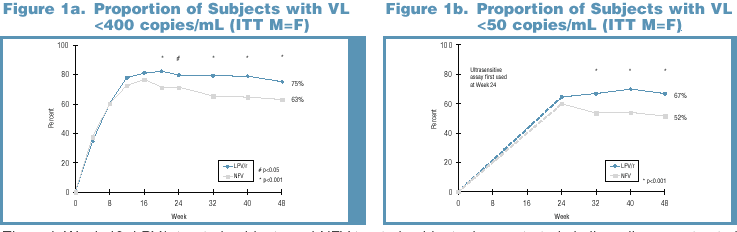
Through Week 48, LPV/r-treated subjects and NFV-treated subjects demonstrated similar adherence to study medications.1
OBJECTIVE
To characterize the incidence of resistance through 48 weeks in a randomized double-blind, Phase III study comparing the efficacy and safety of LPV/r plus d4T and 3TC to that of NFV plus d4T and 3TC in ARV-naïve subjects.
METHODS
Genotypic/Phenotypic Resistance
Samples were analyzed from all subjects with viral load >400 copies/mL at Weeks 24, 32, 40 or 48. Genotype (GeneSeq ™ ) and phenotype (PhenoSense ™ ) were performed by ViroLogic, Inc. Genotypic resistance to NFV was defined as the presence of a D30N and/or L90M mutation in protease. Genotypic resistance to LPV was defined as the presence of any primary or active site mutation in protease (amino acids 8, 30, 32, 46, 47, 48, 50, 82, 84 and 90).2 Phenotypic analyses were performed on all samples obtained from LPV/r-treated subjects to confirm the lack of genotypic resistance to LPV. Resistance to 3TC was defined as the presence of an M184V or M184I mutation in reverse transcriptase.
Adherence
Adherence was measured by pill counts of protease inhibitor (non-placebo). The adherence between each study visit and overall was computed as the percentage of pills consumed relative to the expected number consumed. The "minimum adherence rate" was defined as the lowest of the adherence rates between visits.
Analysis of Exposure to Viral Replication
A total of 58 LPV/r-treated and 102 NFV-treated subjects had a viral load >400 copies/mL at Weeks 24, 32, 40, or 48. For subjects with multiple viral loads >400 copies/mL during Weeks 24-48, the latest sample was used for genotypic analysis, unless resistance had been previously identified at Week 24. Samples selected for analysis are summarized in Table 1.

Statistics
P-values for categorical variables were based on Fisher’s exact test. Quantitative variables were analyzed using a one-way analysis of variance.
RESULTS
Lower Incidence of Resistance in LPV/r-Treated Subjects
Viral isolates from 37/58 LPV/r-treated subjects and 76/102 NFV-treated subjects could be amplified for genotype.
None of the 37 LPV/r-treated subjects demonstrated genotypic or phenotypic resistance to LPV.
In comparison, 25/76 (33%) NFV-treated subjects demonstrated genotypic resistance to NFV.
The absence of resistance to LPV was confirmed in 36/37 samples by phenotypic analysis. Phenotypic data were not available for one LPV/r-treated subject for whom genotypic data were analyzed.
3TC resistance was noted in both treatment groups but was significantly more frequent in NFV-treated subjects than in LPV/r-treated subjects [15/37, (41%) vs. 62/76, (82%) p<0.001].
None of the D30N or L90M mutations were present in the 23 available baseline sequences of the 25 NFV-treated subjects who demonstrated those mutations following viral rebound.
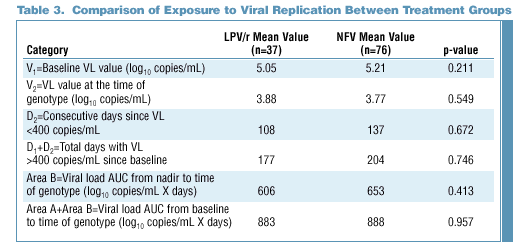
No Differences in Exposure to Viral
Replication Observed Between Treatment Groups
Genotypic resistance in protease was detected in 0/37 (0%) of ABT-378/r-treated
subjects and 25/76 (33%)
NFV-treated subjects (p<0.001). Viral load data were examined to explore
whether differences in exposure to viral replication may have accounted for the
differences in the incidence of resistance.
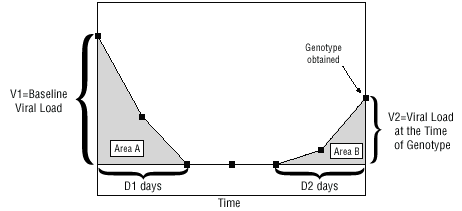
Figure 2 provides an illustration of the variables examined in the comparison of exposure to viral replication:
Baseline HIV RNA level (illustrated by value V1)
HIV RNA at the time of genotype (V2)
Days since viral load was suppressed below 400 copies/mL (D2)
Total days viral load was above 400 copies/mL since baseline (D1 +D2)
Viral load area under the curve (AUC) since viral load was suppressed (Area B)
Viral load area AUC since baseline (Area A + Area B)
Figure 2. Viral Exposure Illustration
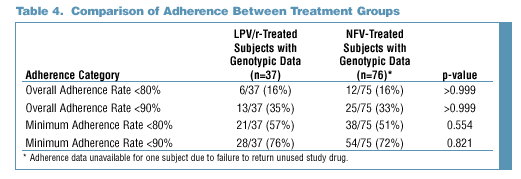
Adherence was Similar Between Treatment Groups Among Subjects with Genotypic Data
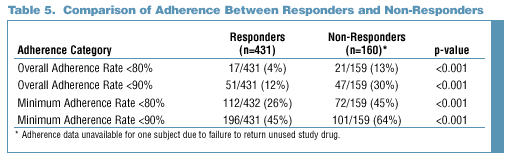
Responders Had Better Adherence Than Non-Responders
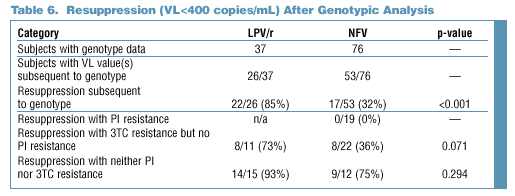
LPV/r-Treated Subjects
CONCLUSIONS
REFERENCES


© 2001 Medical Advocates
for Social Justice
225 West Washington Street, Suite 2200, Chicago, IL 60606
Telephone (312) 419-7289 Facsimile: (312) 419-7151
Email: [email protected]