Medical Advocates for Social Justice
Conference
Poster
 |
5th International
Congress on Drug Therapy
in HIV Infection
|
|
|
||
|
|
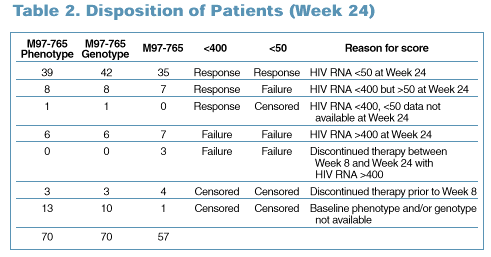
SHARE THIS POSTER WITH A COLLEAGUE INTRODUCTION The use of phenotypic and genotypic resistance testing can provide useful information to guide therapy in treatment-experienced patients. However, the results of these tests require interpretation in a clinically relevant context. For example, quantifiable changes in drug susceptibility, compared to wild type (wt) virus, may be clinically irrelevant if plasma drug concentrations are high relative to the wt EC50. For most protease inhibitor (PI) containing regimens that have been studied, a 4-fold change in baseline phenotype and/or the presence of 1-2 key baseline PI mutations are associated with diminished virologic response. This observation is consistent with mean Ctrough values for these PIs that range from 1- to 4-fold above the EC50 for wt HIV (i.e., inhibitory quotient, defined as the Ctrough/serum adjusted EC50 ratio, of 4 or less). Kaletra™ (lopinavir/ritonavir, formerly known as ABT-378/r) is a new protease inhibitor that, by virtue of its high (>75) inhibitory quotient for wt HIV, has shown antiviral activity in patients whose viral isolates contain multiple PI mutations and display substantially reduced phenotypic susceptibility to ABT-378. In order to provide an interpretive context for phenotypic and genotypic resistance testing with Kaletra, we performed a cross-study analysis of the Week 24 response in twoPhase II studies of ABT-378/r plus a non-nucleoside reverse transcriptase inhibitor (NNRTI) and 2 nucleoside reverse transcriptase inhibitors (NRTIs) in PI experienced, NNRTI naïve patients with respect to baseline phenotype and baseline genotype. Study M97-765 is a Phase II dose ranging clinical trial designed to evaluate two doses of ABT-378/r (400/100 mg BID and 400/200 mg BID) in patients with plasma HIV RNA between 1,000 and 100,000 copies/mL while on therapy with their first PI (plus 2 NRTIs) regimen at the time of screening. Patients entering Study M97-765 were naïve to ABT-378/r, nevirapine (NVP) and at least one of the two investigator-selected NRTIs. Patients changed their PI to ABT-378/r for the first two weeks of the study (while continuing the NRTIs from their regimen at study entry) and were to add NVP and change NRTIs on Day 15. Study M98-957 is an open-label Phase II clinical trial designed to evaluate the antiviral activity of ABT-378/r (400/100 mg BID and 533/133 mg BID) in patients with plasma HIV RNA >1,000 copies/mL on either sequential and/or simultaneous therapy with at least two PIs at the time of screening. Patients entering Study M98-957 were naïve to and simultaneously initiated therapy with ABT-378/r, efavirenz (EFV) and investigator selected NRTIs. METHODS Virologic Response Plasma HIV RNA was quantified using the Roche Amplicor HIV-1 Monitor™ (Standard Procedure lower limit of quantitation [LLQ] 400 copies/mL, UltraSensitive Procedure LLQ 50 copies/mL [for Study M98-957]) and the Abbott Laboratories LCx™ 1 HIV RNA Quantitative Assay (LLQ 50 copies/mL [for Study M97-765]). Phenotype Baseline phenotype to commercially available antiretroviral agents and to ABT-378 was measured by the PhenoSense™ or Antivirogram™ methods and expressed as fold change in EC50 compared to the phenotype of the standard, wt virus (pNL4-3 for PhenoSense™ and HXB2 for Antivirogram™). The association between phenotype at baseline and the binary response variable (plasma HIV RNA <400 copies/mL [<50 copies/mL] or >400 copies/mL [>50 copies/mL]) at Week 24 was analyzed using Fisher’s exact test and univariate logistic regression. Genotype Baseline genotype, including the entire protease and reverse transcriptase genes, was determined by population sequencing. The ABT-378 mutation score for each isolate was defined as the number of mutations selected from the following eleven mutations in protease: L10F/I/R/V, K20M/R, L24I, M46I/L, F53L, I54L/T/V, L63P, A71I/L/T/V, V82A/F/T, I84V and L90M, which have been previously associated with changes in susceptibility to ABT-378. 2 The association between the baseline ABT-378 mutation score and the binary response variable (plasma HIV RNA <400 copies/mL [<50 copies/mL] or >400 copies/mL [>50 copies/mL]) at Week 24 was analyzed using Fisher’s exact test and univariate logistic regression. RESULTS Subjects Analyzed
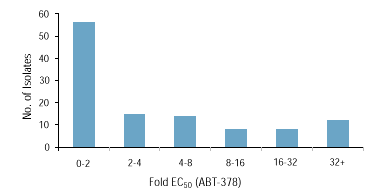
Virologic Response with Respect to Baseline Phenotype The median (range) baseline susceptibility to ABT-378 (n=113 patients) at baseline was 2.3-fold (0.5-96 fold). Baseline phenotype data are presented in Figure 1. Figure 1. Susceptibility of Baseline Viruses to ABT-378
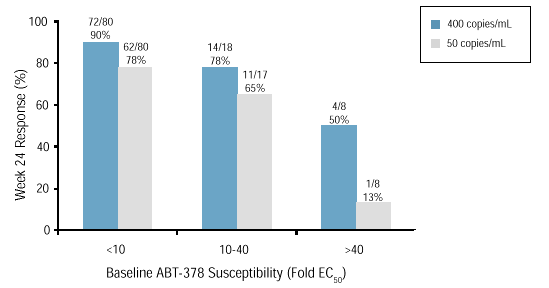
Observed virologic response rates at Week 24 (n=106) with respect to baseline susceptibility p=0.0007 for <50 copies/mL, Fisher’s exact test). Figure 2. Week 24 Response in Combined Studies with Respect to Baseline Phenotype
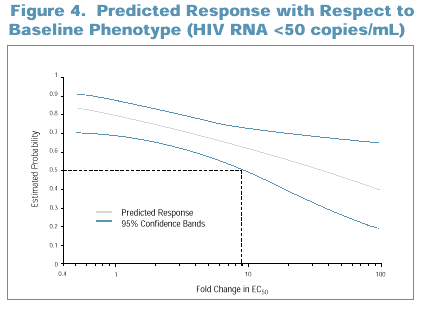
Using univariate logistic regression, estimated models of virologic response at Week 24 were of similar shape using either <400 or <50 copies/mL as a cutoff (p<0.04). Estimated virologic response rates (with 95% confidence bands) as a function of the fold change in EC50 are presented in Figures 3 and 4. Using the lower (conservative) 95% confidence bands from the logistic regression models, the estimated probability of response at Week 24 (<400 and <50 copies/mL) was 50% or greater in subjects whose baseline isolates displayed up to 38-fold and 8-fold, reduced susceptibility to ABT-378, respectively. These results also suggest that clinically relevant resistance to ABT-378/r can be estimated by the baseline ABT-378 mutation score: the presence of 8 or more
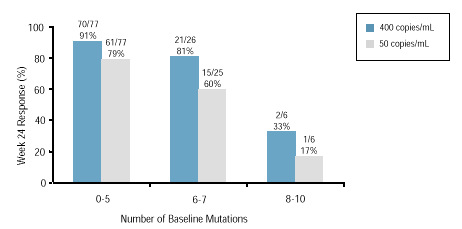
N T R O D U C T I O N Virologic Response with Respect to Baseline Genotype The median (range) baseline ABT-378 mutation score (n=116 patients) was 4 (0-10). The ABT-378 mutation score of the baseline isolates are summarized in Figure 5. Figure 5. ABT-378 Mutation Score of Baseline Isolates Observed virologic response rates at Week 24 (n=109) with respect to the baseline ABT-378 mutation score are shown p=0.0021 for <50 copies/mL, Fisher’s exact test). Figure 6. Week 24 Response in Combined Studies with Respect to Baseline Genotype
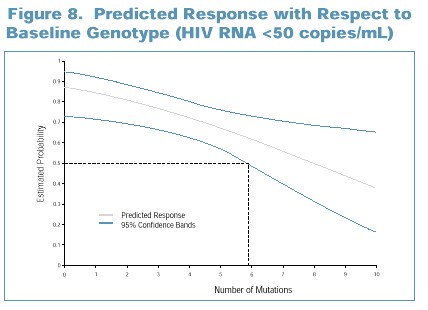
Using univariate logistic regression, estimated models of virologic response at Week 24 were of similar shape using either <400 or <50 copies/mL as a cutoff (p<0.04). Estimated virologic response rates (with 95% confidence bands) as a function of the number of baseline mutations are presented in Figures 7 and 8. Using the lower (conservative) 95% confidence bands from the logistic regression models, the estimated probability of response at Week 24 (<400 and <50 copies/mL) was 50% or greater in subjects whose baseline ABT-378 mutation scores of 7 or less and 5 or less, respectively.
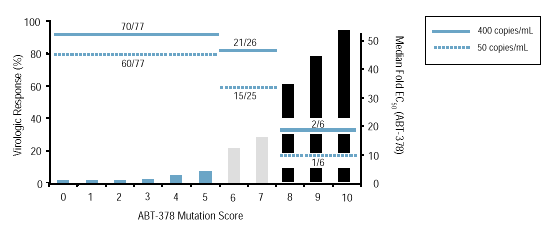
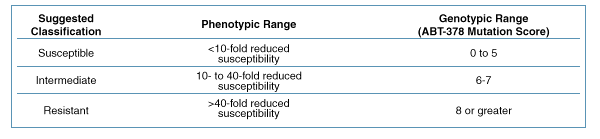
The relationship of virologic response, median baseline phenotypic susceptibility to ABT-378, and baseline ABT-378 mutation score is shown in Figure 9. Isolates with 5 or fewer mutations displayed median fold EC50 values of 10 or less and were clinically susceptible to Kaletra therapy. Isolates with 6-7 mutations displayed intermediate median susceptibility in vitro (>10-fold but <40-fold) and were of intermediate clinical susceptibility to Kaletra. Figure 9. Relationship of Phenotype, Genotype and Virologic Response to ABT-378/r in Studies M97-765 and M98-957
CONCLUSIONS These results suggest that ABT-378/r, as used in these studies, exerts significant antiviral activity in vivo, even in patients with HIV that displays up to 40-fold reduced susceptibility to ABT-378 at baseline. This is consistent with the inhibitory quotient for ABT-378/r against wild type HIV, which is estimated to be >75. These results also suggest that clinically relevant resistance to ABT-378/r can be estimated by the baseline ABT-378 mutation score: the presence of 8 or more mutations (of the 11 identified to be associated with changes in susceptibility to ABT-378/r) may substantially compromise response. Furthermore, the number of these protease mutations, rather than the presence of any single key mutation, is the best genotypic predictor of virologic response to ABT-378/r. These results may be useful for interpreting phenotypic and genotypic resistance testing with ABT-378/r using the following categories:
ACKNOWLEDGMENTS Genotype and Phenotype testing
was performed by VIRCO, Inc. and ViroLogic, Inc.
Poster F148-F149 © 2000 Medical Advocates for Social Justice |