|
SHARE THIS POSTER WITH A COLLEAGUE
BACKGROUND
ABT-378/r is a novel
HIV protease inhibitor (PI) that has shown significant antiviral activity and
tolerability in clinical trials to date. ABT-378/r is co-formulated with
ritonavir, an inhibitor of cytochrome P450 3A. It is uniquely sensitive to
pharmacokinetic enhancement by ritonavir, resulting in substantially increased
ABT-378 drug exposure, even at low ritonavir doses. The mean ABT-378 C trough
/EC 50 ratio (inhibitory quotient or IQ) for wild-type HIV is >75 when dosed
at 400/100 mg BID, contributing to durability and potentially providing a
pharmacologic barrier to the emergence of viral resistance. 1 The efficacy and
safety of ABT-378/r are currently being studied in both antiretroviral-naïve
and PI-experienced HIV-infected subjects. Study M98-863 further examines the
antiviral activity of ABT-378/r in a large, blinded, randomized, prospective
study comparing the activity and safety of ABT-378/r to that of nelfinavir
(NFV).
At Week 24, 92% of ABT-378/r-treated
subjects and 81% of NFV-treated subjects had viral load (VL) <400 copies/mL
(on treatment, p<0.001). In order to gain insight into the development of
resistance in subjects receiving ABT-378/r, the plasma viral isolates from all
subjects with VL >400 copies/mL while on treatment at Week 24 (ABT-378/r:
n=25. NFV: n=54) were examined for viral resistance.
METHODS
-
Genotype (population sequencing)
and phenotype (PhenoSense™) were performed by Virologic, Inc.
-
Resistance to NFV was defined as
the presence of a D30N and/or an L90M mutation in protease. Resistance to
ABT-378 was defined as the presence of any primary or active site mutation.
2 Genotypic analysis was performed on all samples. Phenotypic analysis was
also conducted on each Week 24 sample from ABT-378/r-treated subjects.
Resistance to 3TC was defined as the presence of an M184V/I mutation in
reverse transcriptase.
-
Adherence was measured by
protease inhibitor pill count of returned capsules at each visit. Overall
adherence was defined as the percentage of capsules taken (relative to the
number specified by the protocol) over the first 24 weeks. Adherence was
also computed between monthly visits, and the “minimum adherence rate”
was defined as the lowest of the monthly adherence rates.
-
P-values were computed using
Fisher’s exact test or Pearson’s chi-square test. Adults (Week 36-96)
Children (Week 24-32) Naïve subjects enrolled in study n=100 n=44 Subjects
with resistance data following rebound 4 8 Subjects genotype resistant to
ABT-378 0 0 Subjects resistant to 3TC 2/4 2/8 Subjects with a resuppression
after rebound 2/4 6/8 Viral Resistance in Other Naïve Subjects Table 6.
Other Resistance Data from Naïve Subjects in Phase II Studies
RESULTS
Incidence of Resistance in Viral Isolates from
M98-863 Subjects at Week 24
At Week 24, plasma viral isolates
from all subjects with VL >400 copies/mL were examined for evidence of
PI-resistance (Table 1).
Among subjects whose VL
were >400 copies/mL at Week 24, 24/25 ABT-378/r-treated and 51/54
NFV-treated subjects had a viral load reduction from baseline of >2.0 log
10 copies/mL or a VL <400 copies/mL at some point prior to Week 24.
Viral resuppression was
significantly more common in ABT-378/r-treated subjects than in NFV-treated
subjects; 74% of ABT-378/r-treated subjects demonstrated resuppression at
least once compared to 22% of NFV-treated subjects.
In spite of the presence
of 3TC resistance, 4/8 (50%) ABT-378/r-treated subjects experienced viral
resuppression compared to 3/21 (14%) NFV-treated subjects.
None of the NFV-treated
subjects who demonstrated a D30N or L90M protease mutation at Week 24
experienced viral suppression at any time point after Week 24.
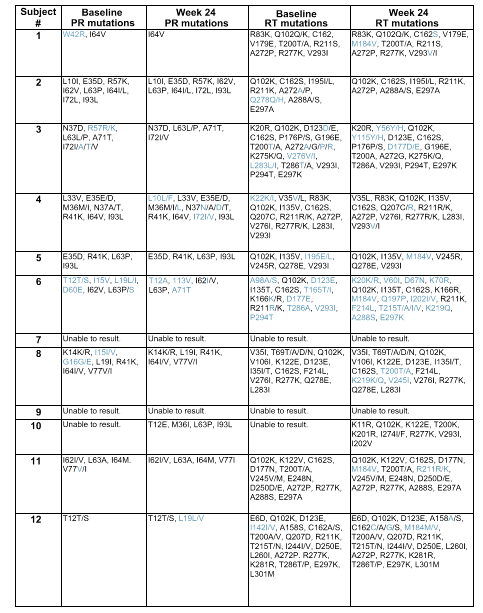
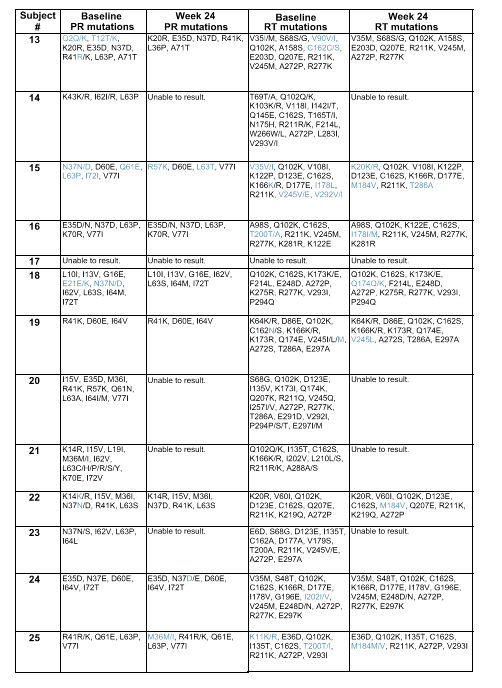
Table 3. M98-863: Baseline and
Week 24 Genotype Comparison for ABT-378/r-Treated Subjects*
 R E S U L T S R E S U L T S
* Blue texts indicate mutations
not present in both Baseline and Week 24 sequences.
Adherence
Viral Resistance in Other Naïve
Subjects
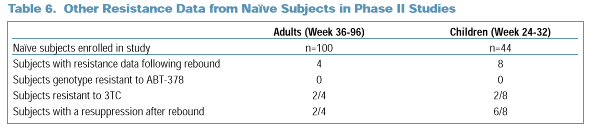
- Resistance testing from
antiretroviral-naïve subjects treated with ABT-378/r in phase II studies
has demonstrated results similar to those seen in this phase III study.
- All subjects received
3TC in both studies. Among antiretroviral-naïve subjects with genotype data
available, 2/4 adult subjects and 2/8 pediatric subjects showed 3TC
resistance.
CONCLUSIONS
ABT-378/r is a new PI
that displays significant virologic potency in treatment-naïve subjects. To
date, no viral resistance to ABT-378 has been observed in subjects who
initiated their antiretroviral therapy with ABT-378/r.
In contrast, 15/40
NFV-treated subjects developed NFV resistance by Week 24.
3TC resistance was significantly
more common in NFV-treated subjects than in ABT-378/r-treated subjects (90%
vs. 44%).
The absence of resistance
in naïve subjects treated with ABT-378/r is consistent with its high inhibitory
quotient (C trough /EC 50 ratio) and suggests a high barrier to resistance.
REFERENCE
- Bertz R, Lam W, Brun S, et al. Multiple-dose
pharmacokinetics (PK) of ABT-378/ritonavir (ABT-378/r) in HIV+ subjects. 39th
Interscience Conference on Antimicrobial Agents and Chemotherapy, San Francisco,
USA, 1999 (Abstract 0327).
- Hirsch, MS, et al. Antiretroviral drug
resistance testing in adults with HIV infection: implications for clinical
management. International AIDS Society–USA Panel. JAMA 1998;279:1984-91.
Lack of Resistance
to Kaletra formerly known as ABT-378/r) Observed Through 24 Weeks of
Therapy in Antiretroviral-Naïve Subjects
© 2000 Medical Advocates
for Social Justice
|