|
SHARE THIS POSTER WITH A COLLEAGUE
BACKGROUND
ABT-378 (lopinavir) is a novel
HIV protease inhibitor (PI) that is co-formulated with ritonavir, an inhibitor
of cytochrome P450 3A. It is exquisitely sensitive to pharmacokinetic
enhancement by ritonavir, resulting in substantially increased ABT-378 drug
exposure, even at low ritonavir doses. At the dosage selected for phase III
clinical trials, 400 mg ABT-378/100 mg ritonavir BID (as 3 co-formulated
capsules BID), ritonavir concentrations are below those required for antiviral
activity. 1 The mean ABT-378 C trough /EC 50 ratio
(Inhibitory Quotient or IQ) for wild-type HIV is > 75 when dosed at
400/100 mg BID, potentially providing a pharmacologic barrier to the emergence
of viral resistance and activity against resistant virus. 1 In contrast, the IQs
for currently available Pls whether dosed as single PIs or in conjunction with
ritonavir, range from 1-26 (Figure 1), based on the EC 50 values determined in
the presence of 50% human serum. 2 C trough values
in HIV+ patients for currently available PIs are derived from published sources
including package inserts. 3-14
The efficacy and safety of
Kaletra (lopinavir/ritonavir, formerly known as ABT-378/r) are currently being
studied in HIV-infected patients, both antiretroviral-naïve and PI-experienced.
The M97-720 study is an ongoing phase II double-blind trial of ABT-378/r in
combination with d4T and 3TC in antiretroviral-naïve patients. Results
through Week 108 as well as results from an ultra-sensitive HIV RNA assay with a
level of quantitation of 3 copies/mL are presented here.
Figure 1. Ctrough
/EC Ratio (Inhibitory Quotient) for PIs Given Alone or with RTV*
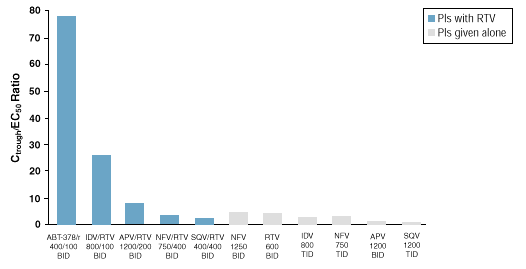
* Contribution of RTV to
antiviral activity not included; regimens shown are those where data in
HIV-infected patients are available; EC 50 values adjusted for protein binding.
METHODS
Entry Criteria
Antiretroviral-naïve
patients.
Plasma HIV RNA >
5,000 copies/mL with no CD4 cell count restriction.
Study Design and Analysis
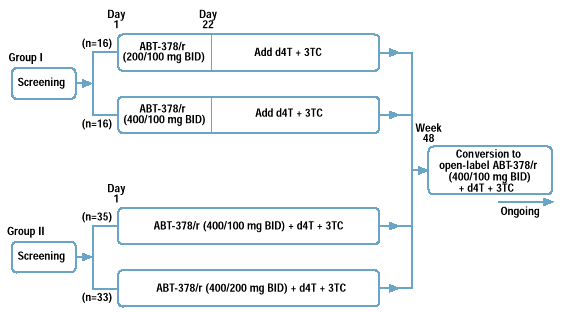
One hundred
antiretroviral-naïve patients were randomized to receive one of three dosage
levels of ABT-378/r (200/100 mg BID, 400/100 mg BID or 400/200 mg BID),
together with d4T (40 mg BID) and 3TC (150 mg BID) given either after 3 weeks
of monotherapy (Group I) or from study entry (Group II) (Figure 2).
Enrollment into Group II
began following an evaluation of preliminary efficacy and safety of ABT-378/r in
Group I.
After 48 weeks, all
patients began conversion to open-label ABT-378/r 400/100 mg BID dosing.
Plasma HIV RNA was
quantified using Roche Amplicor HIV-1 Monitor ™ (lower limit of quantitation [LLQ]
400 copies/mL) and the Roche Amplicor HIV-1 Monitor Ultrasensitive Quantitative
PCR, Version 1.0 (LLQ 50 copies/mL). Samples from patients with HIV RNA <50
copies/mL at Weeks 24, 48, or 72 were analyzed using an experimental
modification of the standard Roche Amplicor HIV RNA previously described by
Perrin et al. This modified assay allows for a limit of quantitation of 3
copies/mL.15
Figure 2. M97-720
Study Schema
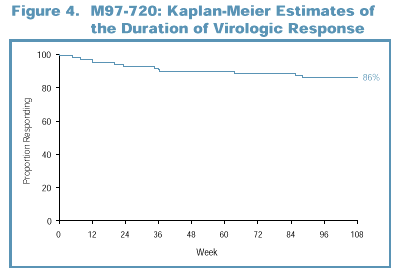
Duration of Virologic Response
Definition
Duration of virologic response
was defined as the time from study initiation to the time of loss of virologic
response (two consecutive HIV RNA measurements above 400 copies/mL following any
measurement below 400 copies/mL). If the final measurement for a patient was
above 400 copies/mL (and the patient had not previously demonstrated a loss of
response), the time of loss of response was defined to be the time of the last
measurement. Subjects who had never experienced a loss of response were
considered censored at the time of their final measurement, including subjects
who prematurely discontinued prior to demonstrating a loss of response.
Subjects who never achieved an HIV RNA level below 400 copies/mL were considered
to have had a loss of response at Day 1.
RESULTS
Baseline Characteristics
Ninety-six male and
4 female patients: 65% Caucasian, 29% Black, 6% Hispanic.
Mean age: 35 years (range
21-59).
Median Plasma HIV RNA:
4.8 log 10 copies/mL (range 3.3-6.3).
Median CD4 count: 326
cells/mm3 (range 3-918).
Viral Load Suppression to <400
Copies/mL at 108 Weeks
On-treatment
analysis: 99% of patients had viral load (VL) <400 copies/mL (Figure 3).
Intent-to-treat analysis
(ITT M=F; missing values considered as treatment failure): 80% of patients had
VL <400 copies/mL (Figure 3)
Figure 3. M97-720
HIV RNA <400 Copies/mL Through Week 108
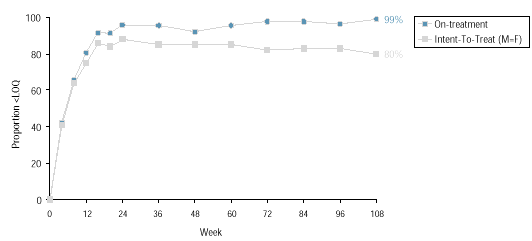
Duration of Virologic Response
Analysis
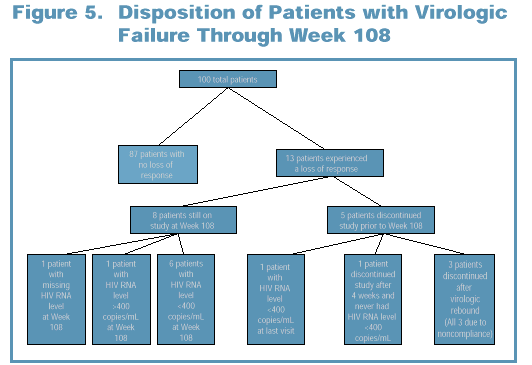
54% (7/13) of
antiretroviral-naïve patients who met loss of response criteria subsequently
had viral load <400 copies/mL at the Week 108 evaluation or last visit (Figure
5).
RESULTS
Viral Load Suppression with
Ultrasensitive Assays
At 96 Weeks by
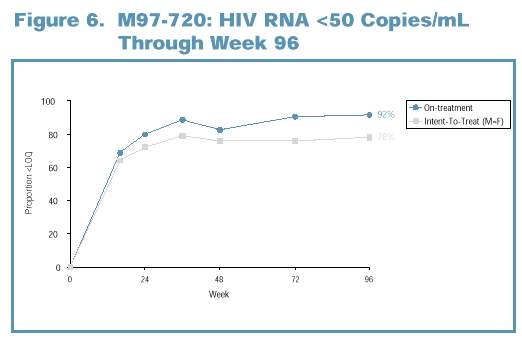
Roche Ultrasensitive testing, HIV RNA was <50 copies/mL in 92% of patients on
treatment (ITT M=F: 78%) (Figure 6).
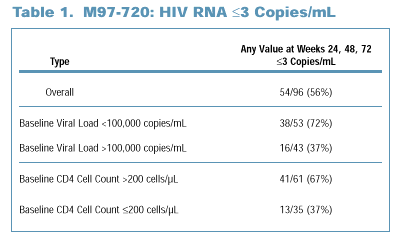
56% (54/96) of patients
on treatment demonstrated a viral load 3 copies/mL for at least one visit (Table
1).
72% (38/53) of patients
with BL HIV RNA <100,000 copies/mL achieved a viral load 3 copies/mL for at
least one visit compared to only 37% (16/43) of those with BL HIV RNA >100,000
copies/mL (Table 1).
67% (41/61) of patients
with BL CD4 cell count >200 cells/µL achieved a viral load 3 copies/mL for at
least one visit compared to only 37% (13/35) of those with BL CD4 cell counts
<200 cells/µL (Table 1).
CD4 Cell Response
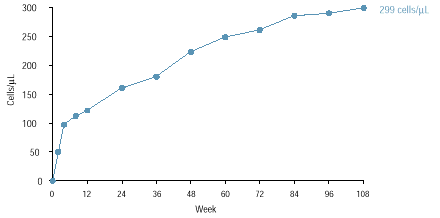
The mean CD4 cell
count at Week 108 was 599 cells/mm3 and the mean increase from
baseline was 299 cells/mm3.
The mean increase in CD4
count was consistent regardless of baseline CD4 cell count. Among 17 patients
with baseline CD4 cell count <50 cells/mm3 , the mean increase to
Week 108 was 295 cells/mm3.
Figure 7. CD4 Cell
Count (Mean Change from Baseline)
CONCLUSIONS
- ABT-378/r exhibits a
potent and durable antiviral effect through 108 Weeks in antiretroviral-naïve
patients, with VL <400 copies/mL in 99% of patients on treatment (ITT M=F:
80%).
Of patients who met
criteria for loss of virologic response, 54% (7/13) subsequently had a viral
load <400 copies/mL at Week 108 or final evaluation.
While over 50% of
patients on ABT-378/r therapy through 72 weeks had at least one HIV RNA value 3
copies/mL, achieving viral suppression to this level was more likely in patients
with higher CD4 counts and lower viral loads at baseline.
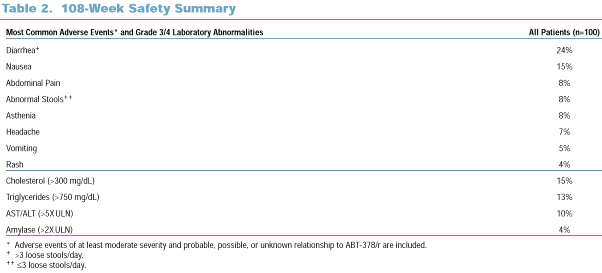
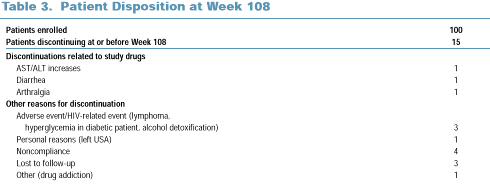
ABT-378/r was well
tolerated with only three patients out of 100 discontinuing due to adverse
events related to study drug through 108 Weeks.
Early use of ABT-378/r is
supported by the tolerability profile and durable antiviral activity observed to
date.
REFERENCES
- Bertz R, Lam W, Brun S, et al.
Multiple-dose pharmacokinetics (PK) of ABT-378/ritonavir (ABT-378/r) in HIV+
subjects. 39th Interscience Conference on Antimicrobial Agents and
Chemotherapy, San Francisco, USA, 1999 (abstract 0327).
- Kempf DJ, Molla A, Hsu A.
Protease inhibitors as anti-HIV agents. Antiretroviral Therapy, American
Society for Microbiology Press, E DeClerq, editor. In press.
- Ritonavir Package Insert.
- Indinavir Package Insert.
- Amprenavir Package insert.
- Nelfinavir Package Insert.
- Saquinavir (Fortavase) Package
Insert.
- Cohen C, et al. Potent and convenient
Fortovase™ (SQV) SGC BID regimens in combination with 2 nucleosides or
nelfinavir (NFV) plus 1 nucleoside in HIV-1 infected patients. 12th World AIDS
Conference, Geneva, Switzerland, 1998, (abstract 12314).
- Saag M, et al. Saquinavir systemic
exposure and safety on once daily administration of Fortovase ™ (Saquinavir)
soft gel capsules (FTV) in combination with low-dose ritonavir. 39th
Interscience Conference on Antimicrobial Agents and Chemotherapy, San
Francisco, USA, 1999, (abstract 330).
- Shulman N, et al. Ritonavir
intensification in indinavir recipients with detectable HIV RNA levels. 7th
Conference on Retroviruses and Opportunistic Infections, San Francisco, USA
(abstract 534).
- Piscitelli S, et al. The
addition of a second protease inhibitor eliminates Amprenavir-Efavirenz drug
interactions and increases plasma Amprenavir concentrations. 7th Conference on
Retroviruses and Opportunistic Infections, San Francisco, USA (abstract 78).
- Mallolas J, et al. A
dose-finding study of once-daily Indinavir/Ritonavir plus Combivir ® in HIV
infected patients. First International Workshop on Clinical Pharmacology of
HIV Therapy, March 2000 (abstract 2.14).
- Flexner C, et al. Steady-state
pharmacokinetic interactions between ritonavir (RTV), nelfinavir (NFV), and
the nelfinavir active metabolite M8 (AG1402), 12th World Aids Conference,
Geneva (abstract 42265).
- Cameron DW, et al. Ritonavir
and saquinavir combination therapy for the treatment of HIV infection. AIDS,
1999, 12(2) 213-224.
- Yerly S., Rutschmann O.T.,
Perrin L. et al. Cell-Associated HIV-1 RNA in Blood as Indicator of Virus Load
in Lymph Nodes. The Journal of Infectious Diseases, 1999;180:50-3.
ACKNOWLEDGMENTS
- M97-720 Study Subjects
- Covance Central Laboratory
Services
- AIDS Research Consortium of
Atlanta
Sullivan M, Bohn H, Enstrom T
- Beth Israel Deaconess Medical
Center Fitch
H, Koziol C
- Cornell Clinical Trials Unit
Sarraco T, Stroberg T
- Duke University Medical Center
Giner J, Harmon L
- Northwestern University
Werry A, Bruce J, Donath P
- Pacific Oaks Research
Perry B, Walker S
- Rush Presbyterian St. Luke’s
Medical Center
Narkiewicz E
- Thomas Street Clinic
Sepcie B
- University of Colorado
Canmann S, Putnam B, Ray MG
- University of North Carolina
at Chapel Hill
Marcus C, Ngo L
- PPD Development
McCarley S, Donnelly A, Jackson S, Nicks B
- Abbott Laboratories
Kempf D, Potthoff A, Rode R, Sheehan K, Yang G
- Laboratory of Virology, U.
Geneva Yerly S, Wegmann L
|