Medical Advocates for Social Justice
Conference
Poster
8th Conference on Retroviruses and Opportunistic Infections.
Chicago, IL USA February 4-8,
2001
Comparison
of Time to Achieve HIV RNA <400 copies/mL and <50 copies/mL in a
Phase III, Blinded, Randomized Clinical Trial of Kaletra vs. NFV in ARV-Naïve
Patients. M. King, B. Bernstein, D.
Kempf, J. Moseley, K. Gu, P. Cernohous, and E. Sun. [329]
Abbott Laboratories,
Abbott Park, IL, for the M98-863 Study Group
Decreases in HIV RNA below 400 copies/mL or 50
copies/mL are typically examined at Week 24 as interim endpoints for comparative
clinical trials. While Week 24 is well established for the <400 copies/mL
endpoint, the appropriate time for the <50 copies/mL endpoint has not been
adequately characterized. Patients with high baseline viral loads may not
decline to <50 copies/mL within 24 weeks even with maximal suppression of
replication.1 Declines in HIV RNA level below 50 copies/mL have been shown to be
predictive of a more durable virologic response than declines to between 50 and
400 copies/mL.2,3 Thus to compare the potential for potent antiretroviral
regimens to achieve long-term suppression using relatively short-term clinical
trials, the optimal time point for the assessment of HIV RNA decline to <50
copies/mL must be determined.
Study M98-863 is a double-blind, randomized trial
comparing the safety and antiviral activity of Kaletra (lopinavir/ritonavir,
formerly known as ABT-378/r) + lamivudine (3TC) + stavudine (d4T) to that of
nelfinavir (NFV) + d4T + 3TC. It is being conducted at 93 centers in 13
countries on 5 continents. To be eligible, subjects were required to have an HIV
RNA level >400 copies/mL and to have had no prior d4T or 3TC use and no more
than 14 days of any other antiretroviral therapy. There was no CD4 cell
count restriction. 653 subjects enrolled. 80% were male and 57% were Caucasian.
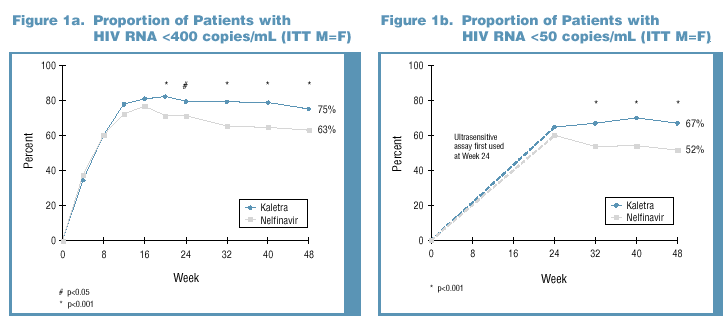
At Week 48, the Kaletra group demonstrated
statistically significantly higher response rates in intent-to-treat
(missing=failure) analyses of the proportion of subjects with HIV RNA levels
below 400 copies/mL (75% vs. 63%, respectively, p<0.001) or below 50 copies/mL
(67% vs. 52%, respectively, p<0.001).4
METHODS
Viral load was measured by the Roche Amplicor
HIV-1 Monitor assay standard method (LOQ=400 copies/mL) at Weeks 4, 8, 12, 16,
and 20, and by both ultrasensitive (LOQ=50 copies/mL) and standard methods at
Weeks 24, 32, 40, 48, 60, and 72. All patients remaining in the study have
completed at least 60 weeks of treatment.
RESULTS
Many Patients Require More than 24 Weeks to
Achieve HIV RNA <50 copies/mL
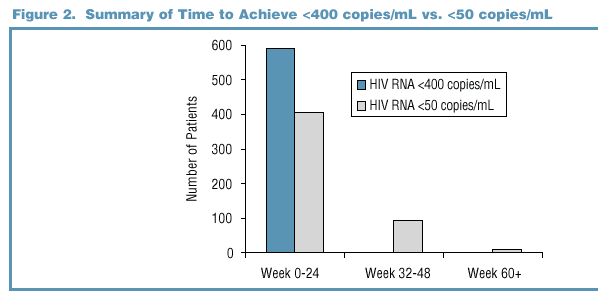
Only 1 of 592 patients (0.2%) who ever
demonstrated HIV RNA <400 copies/mL did so for the first time after Week
24.
In contrast, 99 of 507 patients (20%) who
ever demonstrated HIV RNA <50 copies/mL did so for the first time after Week
24.
Only 7 patients (1.4%) first demonstrated HIV
RNA <50 copies/mL after Week 48 (Figure 2).
Differences Between Treatment
Groups in the Number of Patients Achieving HIV RNA <50 copies/mL Became
Evident After Week 24
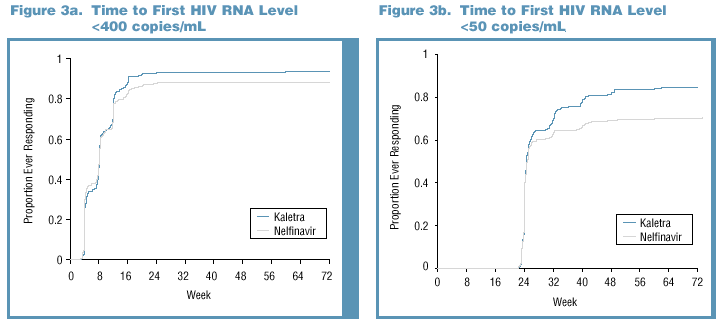
The
culmination proportions of patients achieving HIV RNA values <400 copies/mL
or <50 copies/mL are presented by 3a and 3b.
More Kaletra-treated patients than NFV
patients achieved HIV RNA <50 copies/mL by Week 24, although the difference
between treatment groups was not statistically significant.
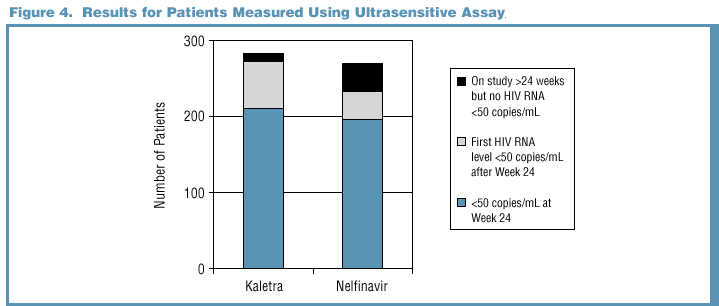
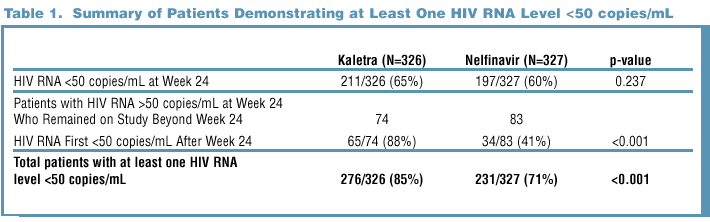
Among patients with HIV RNA >50 copies/mL
at Week 24 who remained on study beyond Week 24, more Kaletra-treated patients
(88%) than NFV-treated patients (41%) achieved HIV RNA <50 copies/mL
(p<0.001) (Figure 4 and Table 1).
Higher Baseline Viral Load is Associated with
Longer Time to Achieve HIV RNA <50 copies/mL
In analyses using data combined from both
treatment groups, patients with baseline HIV RNA levels <100,000 copies/mL
were compared to those with baseline HIV RNA levels >100,000 copies/mL.
Patients with lower baseline HIV RNA levels
achieved HIV RNA <50 copies/mL statistically significantly more quickly
(p=<0.001, log-rank test) than those with higher baseline HIV RNA levels
(Figure 5).
The effect of baseline HIV RNA on the time to
achieve HIV RNA <50 copies/mL was also assessed by comparing mean baseline
viral loads among patients with HIV RNA <50 copies/mL at Week 24 and those
with HIV RNA first <50 copies/mL after Week 24 (Table 2).
As demonstrated in Table 2, patients who took
longer than 24 weeks to achieve HIV RNA <50 copies/mL had a statistically
significantly higher mean baseline viral load than those who achieved HIV RNA
<50 copies/mL at Week 24.
Effect of Baseline HIV RNA on Time to Achieve
HIV RNA <50 copies/mL by Treatment Group
Analyses of the association between baseline
viral load and the time to achieve HIV RNA <50 copies/mL were also performed
within each treatment group.
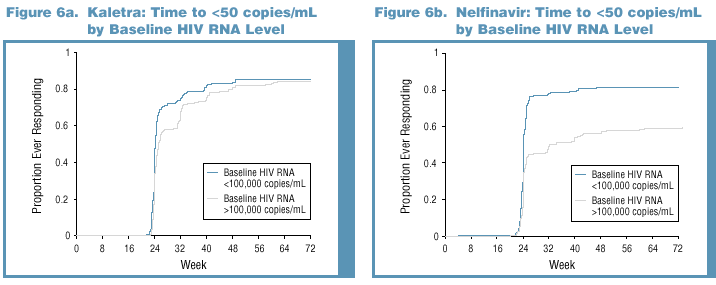
Within each treatment group, patients with
baseline viral load <100,000 copies/mL achieved HIV RNA <50 copies/mL more
quickly than patients with baseline viral load >100,000 copies/mL (Figures 6a
and 6b).
Notably, in the Kaletra group, similar
proportions of patients with baseline HIV RNA >100,000 copies/mL (84%) or
<100,000 copies/mL (85%) ultimately demonstrated an HIV RNA level <50
copies/mL (Figure 6a).
In contrast, in the nelfinavir group, a
significantly lower proportion of patients with baseline HIV RNA >100,000
copies/mL (60%) or <100,000 copies/mL (81%) ultimately demonstrated an HIV
RNA level <50 copies/mL (Figure 6b).
Within each treatment group, the effect of
baseline HIV RNA on the time to achieve HIV RNA <50 copies/mL was also
assessed by comparing mean baseline viral loads among patients with HIV RNA
<50 copies/mL at Week 24 with those with HIV RNA first <50 copies/mL after
Week 24 (Table 3).
Within each treatment group, a statistically
significantly higher mean baseline HIV RNA level was observed for patients with
HIV RNA first <50 copies/mL after Week 24 compared to patients with HIV RNA
<50 copies/mL at Week 24.
Differences between treatment groups in mean
baseline viral loads were not statistically significant either among patients
with HIV RNA <50 copies/mL at Week 24 (4.8 vs. 4.7 log 10 copies/mL, p=0.158)
or among patients with HIV RNA first <50 copies/mL after Week 24 (5.1 vs. 5.3
log 10 copies/mL, p=0.360).
CONCLUSIONS
Almost all patients who ever demonstrated an
HIV RNA level <400 copies/mL had done so by Week 24.
In contrast, a substantial portion (20%) of
those patients who ever achieved HIV RNA levels <50 copies/mL did so for the
first time after Week 24.
More Kaletra-treated patients than
NFV-treated patients ever achieved HIV RNA <50 copies/mL (85% vs. 71%,
p<0.001).
Delayed achievement of HIV RNA <50 copies/mL
was associated with higher baseline HIV RNA levels.
Week 48 may be more appropriate than Week 24
for distinguishing between potent antiretroviral regimens using a limit of
quantitation of 50 copies/mL.
REFERENCES
Moyle GJ, Nelson M, Ruiz N, et al. 2000. Time
to treatment success: 24 weeks is not enough in patients starting with high
viral load in DP-006. 40th ICAAC, Abstract 547.
Drusano, GL, Bilello JA, Stein DS, et al.
1998. Factors influencing the emergence of resistance to indinavir: role of
virologic, immunologic and pharmacologic variables. J. Infect. Dis. 178:360-367.
Raboud, JM, Rae S, Hogg RS, et al. 1999.
Suppression of plasma virus load below the detection limit of a human
immunodeficiency virus kit is associated with longer virologic response than
suppression below the limit of quantitation. J. Infect.
Dis. 180:1347-1350.
Johnson M, Beall G, Badley A, et al. 2000.
ABT-378/r vs. nelfinavir in antiretroviral-naive subjects: Week 48 comparison in
a phase III blinded randomized clinical trial. 5th International Congress on
Drug
Poster 329
Comparison
of Time to Achieve HIV RNA <400 copies/mL and <50 copies/mL in a
Phase
III, Blinded, Randomized Clinical Trial of Kaletra vs. NFV in ARV-Naïve
Patients