Medical Advocates for Social Justice
Conference
Poster
8th Conference on Retroviruses and Opportunistic Infections.
Chicago, IL USA February 4-8,
2001
Protein
Binding of Lopinavir (LPV) and Ritonavir (RTV): In Vitro and Ex
Vivo Data from HIV-infected Patients and Healthy Volunteers..
A Hsu1, R Bertz1, D Hickman1 M Emery1, G Kumar2, J Denissen3, S Vasavanonda1, A Molla.,
H Mo1, D Kempf1, GR Granneman ,
E Sun1. [753]
1 Abbott Laboratories, Abbott Park, IL; 2 Amgen
Inc, Thousand Oaks, CA; 3 Covance Laboratories, Madison, WI
All currently marketed HIV protease inhibitors
(PIs) are bound to plasma proteins (60 to >99%), primarily albumin and á
1 -acid glycoprotein (AGP).
Protein-bound drug generally is considered to
be too large to pass through most cellular membranes to exert
pharmacological actions.
In vitro experiments indicate that binding to
plasma proteins indeed reduces the antiviral activity of PIs.1-4 Clinical data
support these in vitro observations.5
In vitro antiviral activity experiments are
normally conducted in medium containing 10% fetal calf serum (FCS). In
attempts to more realistically estimate the in vitro antiviral potency for
protein-bound PIs, the 10% FCS medium has been modified by adding human
serum (HS),1 purified AGP,1-4 or purified human serum albumin (HSA)1 . Use
of these different systems can produce widely varied estimates of
in vitro antiviral potency of PIs.
HIV infection and hepatic impairment can alter
the protein composition of plasma. The effect of these changes on the
binding of PIs is unknown.
Despite being highly protein bound, most HIV
protease inhibitors exert antiviral activity in vivo. In order to understand
the relevance of in vitro determinations to in vivo potency, we investigated
various aspects of plasma protein binding of RTV and LPV.
OBJECTIVES
To assess if HIV infection and/or hepatic
impairment affect the protein binding of LPV or RTV.
To determine free fractions of LPV and RTV in
various in vitro systems that have been used to determine the antiviral
activity of PIs.
To determine the antiviral activity of LPV,
RTV, and other PIs in two in vitro systems.
METHODS
Sources of Plasma and Media
– Healthy volunteers, who had fasted at least 8 hours, had taken no
medication except aspirin
during the preceding seven days and had taken no salicylates
during the preceding 48 hours
– Adult HIV-negative volunteers participating lopinavir/ritonavir
pharmacokinetic studies
– Adult HIV-infected subjects participating lopinavir/ritonavir or
ritonavir Phase II studies
– Fetal calf serum and RPMI 1640 medium were purchased from Gibco Chemical
Co.
– Human serum for mixed lymphocyte cultures was purchased from Sigma
Chemical Co.
Blood was collected into heparinized tubes and
centrifuged to separate cells from plasma
Ultrafiltration Method (Ex vivo HIV-positive
samples)
– Test medium spiked and incubated at 37°C for 15 minutes
– 1 mL -> Centrifree ® Micropartition System (12-14kD cut off)
– Centrifuged 1000-2000 x g in fixed angle rotor at 22°C
– % Bound = 100 – (dpm/mL filtrate / dpm/mL test) x 100%
Equilibrium Dialysis ( In vitro and ex vivo
HIV-negative samples)
– Spectrum Equilibrium Dialysis System
– 1 mL cells – Spectra/Por 2 membrane (12-14kD cut off)
– Test medium with [ 14 C] Drug vs. dialysing medium (Test
medium with serum/plasma component
replaced with 0.02 M phosphate buffer, pH 7.4, containing
0.6% NaCl) at 37°C
– 3 hour equilibration (drug stability tested by radio-HPLC)
– % Bound = [(dpm/mL test – dpm/mL dialysing) / dpm/mL test] x 100%
RESULTS AND DISCUSSION
The binding of LPV (ca. 99%) and RTV (ca. 98%)
ex vivo appeared to be similar in the plasma from both healthy volunteers
(determined by equilibrium dialysis*) and HIV-infected subjects (determined
by ultrafiltration*) (Table 1).
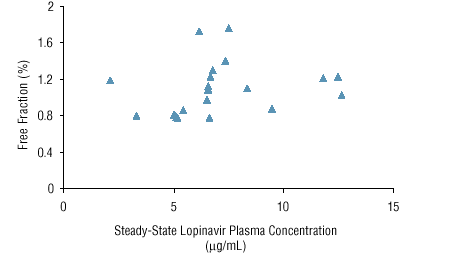
The free fraction of LPV in healthy volunteers
appeared to be relatively constant (0.8%) across the clinical plasma
concentration range (Figure 1).
Multiple dosing did not significantly alter
the plasma protein binding of LPV and RTV in healthy volunteers dosed with
LPV/r for 2 weeks (Table 1).
*In vitro experiments indicate that the LPV free
fraction determined by ultrafiltration averages 1.7 X the value obtained by
equilibrium dialysis (data not shown). Whether this difference also applies to
ex vivo samples is unknown. Assuming this difference, the most conservative
estimated free fraction of LPV at physiological concentrations in the plasma
from HIV-infected subjects (ca. 0.7%) is within the error range of the various
determinations. Ultrafiltration and equilibrium dialysis yielded similar free
fractions of RTV over the clinically relevant concentration range (data not
shown).
Figure 1. Free Fraction (%) of
LPV in the Plasma of Healthy Volunteers After Multiple Dosing
Effect of Mild or Moderate Hepatic Impairment on
the Protein Binding of RTV in HIV-infected Subjects
RTV is significantly bound to albumin;
however, no significant change was observed in plasma protein binding over a
range of albumin concentrations in subjects with varying degrees of
impairment in hepatic function (Table 2).
The effect of hepatic impairment on the free
fraction LPV is currently being evaluated.
The Free Fractions of LPV and RTV at Clinically
Relevant Plasma Concentrations are Closely Approximated in 50% HS plus 10% FCS
The free fraction of lopinavir in 10% FCS +
50% HS media and in whole human plasma was assessed in vitro.
A total LPV concentration range of 0.1-10 µg/mL
was assessed.
At the IC 50 determined in the presence of 50%
HS + 10% FCS (0.06 µg/mL), the estimated free fraction of LPV was ca. 0.65%
(Figure 2 and Table 3).
Similarly, at total mean plasma concentrations
of LPV achieved by dosing LPV/r at 400/100 mg BID (5.5 to 9.6 µg/mL), the
estimated free fraction was 0.6-0.8% in vitro (Table 1 and Table 3)
and 1.1% ex vivo in HIV+ subjects (Table 1).
Figure 2.
The Free Fraction of LPV in 50% HS + 10% FCS at the IC 50 Approximates
or Underestimates the Free Fraction in Patient Plasma
In a similar manner to LPV, at the IC 50 of
RTV determined in the presence of 50% HS + 10% FCS (0.96 µg/mL), the
estimated free fraction of RTV was ca. 0.67% (Figure 3 and Table 4).
At total mean plasma concentrations of RTV
achieved by dosing at 600 mg BID (3.7 to 11.2 µg/mL), the estimated free
fraction was 0.6 to 0.7% in vitro (Figure 3 and Table 4) and ca. 2.0%
ex vivo (Table 1).
Figure 3. The Free Fraction of
RTV in 50% HS + 10% FCS at the IC 50 Approximates or Underestimates
the Free Fraction in Patient Plasma
In Vitro Antiviral
Potency of Protease Inhibitors Determined in 10% FCS + 50% HS
The mean IC 50 values of various protease
inhibitors against three wild-type laboratory HIV strains (IIIB, pNL4-3, and
HXB2) were determined in side-by-side experiments using infected MT4 cells
(Table 5).
Use of In Vitro Data for Development of
Pharmacodynamic Models
Given that the free fraction of LPV and RTV in
human plasma is closely mimicked by media containing 10% FCS and 50% HS, the
in vitro antiviral IC 50 of these drugs may be useful for the
construction of pharmacodynamic models for estimating in vivo potency.
The inhibitory quotient 6 (IQ) is one such
model that characterizes the relationship between drug exposure (C trough )
and drug susceptibility (IC 50 ) (Figure 4).
The inhibitory quotient has been shown to be
predictive of virologic response to LPV/r 7 and RTV/IDV 8 regimens.
Figure 4. Inhibitory Quotient
(IQ): Model for Understanding PI Pharmacodynamics
CONCLUSIONS
The free fractions of LPV and of RTV did not
appear to be affected by HIV infection.
The free fraction of RTV did not appear to be
affected by mild and moderate hepatic impairment. Data on LPV are pending.
The free fraction of RTV and LPV in 10% fetal
calf serum + 50% human serum closely resembles the free fraction of each in
100% human plasma at clinically relevant concentrations.
Therefore, IC 50 values determined in 10%
fetal calf serum + 50% human serum should provide a reasonable estimate for
IC 50 values in 100% human serum.
The free fractions of protease inhibitors in
the media of various in vitro assays used to assess antiviral potency
should be investigated to provide insight into the possible clinical
relevance of data from such assays.
REFERENCES
Molla, A., Vasavanonda, S., Kumar, G., Sham,
H. L., et al. Human serum attenuates the activity of protease inhibitors
toward wild-type and mutant human immunodeficiency virus. Virology 250:
255-262 (1998).
Lazdins J. K., Mestan, J., Goutte, G., Walker,
M. R., et al. In vitro effect of a1-acid glycoprotein on the anti-human
immunodeficiency virus (HIV) activity of the protease inhibitor CGP 61755: A
comparative study with other relevant HIV protease inhibitors. J Infect.
Dis. 175: 1063-1071 (1997).
Bilello, J. A., Bilello, P. A., Prichard, M.,
Robins, T., and Drusano, G. L. Reduction of the in vitro activity of
A77003, an inhibitor of human immunodeficiency virus protease by human serum
α 1-acid glycoprotein. J Infect. Dis. 171: 546-551 (1995).
Bilello, J. A., Bilello, P. A., Stellrecht,
K., Leonard, J, et al. Human serum α 1-acid glycoprotein reduces
uptake, intracellular concentration, and antiviral activity of A80987, an
inhibitor of the human immunodeficiency virus type-1 protease. Antimicrob.
Agents Chemother. 40: 1491-1497 (1996).
Getman, D. P., DeCrescenzo, G. A., Heintz, R.
M., Reed, K. L., et al. Discovery of a novel class of potent HIV-1 protease
inhibitors containing the (R)-(hydroxyethyl)urea isostere. J. Med. Chem. 36:288-291
(1993).
Ellner, P. D., Neu, H. C. The inhibitory
quotient. A method for interpreting minimum inhibitory concentration data. JAMA.
246:1575-8 (1981).
Hsu, A., Granneman, G. R., Kempf, D. J.,
Isaacson, J., et al. The C trough inhibitory quotient predicts virologic
response to lopinavir/ritonavir (ABT-378/ritonavir) therapy in treatment
experienced patients. Fifth International Congress on Drug Therapy in HIV
Infection, Oct. 22-26, Glasgow, UK (2000).
Kempf, D., Hsu, A., Jiang, P., Rode, R. et al.
Response to ritonavir (RTV) intensification in indinavir (IDV) recipients is
highly correlated with virtual inhibitory quotient. 8th Conference on
Retroviruses and Opportunistic Infections, Feb. 4-8, Chicago, IL (2001)