Medical Advocates for Social Justice
Conference
Poster
|
|
|
|
|
Share this Poster with a Colleague Kaletra Library Service Home |
BACKGROUND
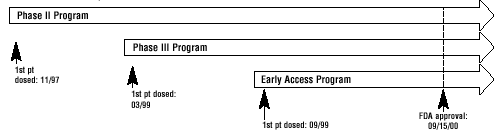
Expanded Access Programs (EAP) are conducted to provide patients with access to potentially life-saving medications prior to marketing authorization for use. Such programs are conducted after sufficient evidence of the safety and effectiveness of the medication has been demonstrated, usually in Phase II clinical trials, and while Phase III clinical trials are ongoing. Kaletra ™ is a co-formulation of lopinavir and ritonavir, with ritonavir employed solely as a pharmacokinetic enhancer. Kaletra was first dosed in an HIV-infected patient in November 1997 and the FDA granted approval for commercial use of Kaletra in the United States (US) on September 15, 2000. Major milestones in the clinical development of Kaletra are depicted below.
KALETRA EAP SCOPE AND LOGISTICS
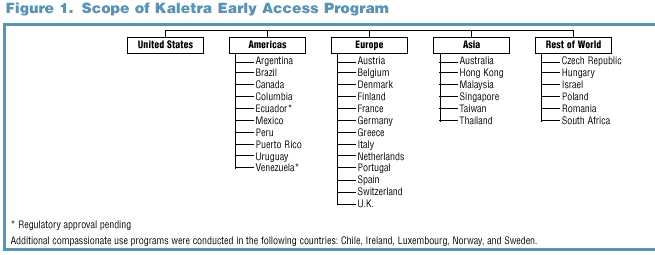
The goal of this global EAP was to provide Kaletra to HIV-infected patients with no other treatment options available, as early in clinical development and under as simple an enrollment process as possible. The Kaletra EAP was initiated while the Phase III clinical trial program was enrolling, approximately one year prior to the first approval of Kaletra for commercial use. Over 35 countries will participate in the Kaletra EAP before its completion (Figure 1).
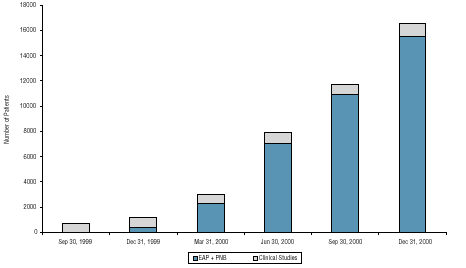
As of December 31, 2000 the overall enrollment in the Kaletra EAP was 11,679 patients, including 8,733 patients with confirmed dosing of Kaletra, from 847 investigators worldwide. At the time of FDA approval, approximately 11,740 patients were taking Kaletra worldwide, either through a clinical trial or compassionate use program, such as EAP or a patient named basis (PNB) program (Figure 2).
Figure 2. Cumulative Number of Patients Enrolled in Kaletra Programs
Challenges Addressed in Program
Due to the large scope of this EAP, implementation and management challenges were inevitable. The following is an abbreviated list of the challenges encountered to date.
METHODS
The objectives of this study were to make Kaletra available to HIV-infected patients through an EAP, and to obtain additional safety information on Kaletra in patients 12 years of age or older with confirmed HIV infection and AST/ALT <5 times the ULN at screening. Due to the nature of the EAP, limited safety and efficacy data were collected. Reporting of serious adverse events (SAEs) was required. Although routine clinical laboratory measurements (e.g., triglycerides, AST/ALT, glucose, etc.) were not collected as part of the EAP, recommendations for the monitoring of these parameters for subsequent patient management were included in the protocol. Sites were monitored by telephone on a monthly basis to verify the status of each patient enrolled at the site, to confirm an adequate clinical drug supply was available at the site, and to verify that all SAEs had been reported to the sponsor. Additional monitoring was conducted in accordance with local regulations. Study sites used local laboratories to assay plasma HIV RNA samples. Since not all study sites used the same HIV RNA assay, a cutoff of 500 copies/mL has been used to summarize study results. Approximately 6% of patients had baseline HIV RNA =500 copies/mL. These patients were excluded from analysis of the efficacy data.
Due to initial drug supply limitations, enrollment was initially limited to patients with a CD 4 count =50 cells/mm 3 and HIV RNA =10,000 copies/mL. However, after one month, the CD 4 criterion was increased to include patients with CD 4 count =200 cells/mm 3 . In January 2000, clinical drug supply became more readily available, therefore, the CD 4 and HIV RNA criteria were eliminated entirely through a protocol amendment. Timing of implementation of the amended protocol varied due to differences in local regulatory requirements.
RESULTS
Summary of Demographic and Disease Characteristics
Screening information is available on 8,733 patients reported to have initiated dosing with Kaletra. The mean baseline HIV RNA and CD 4 count for these patients were 4.8 log 10 copies/mL and 167.5 cells/mm 3 , respectively. In addition, 61.7% of these patients had experienced at least one CDC Class C (AIDS-defining) event. Demographic and disease characteristics are presented in Table 1.
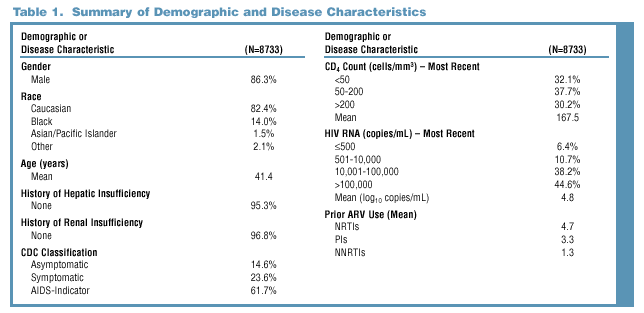
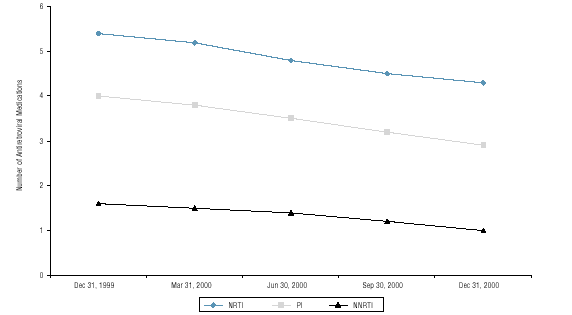
As the inclusion/exclusion criteria for the Kaletra EAP were changed and implemented over time, the mean baseline status of the patient population shifted to less antiretroviral-experienced, healthier patients. Figure 3 displays the mean CD 4 cell count (most recent) at screening, while Figure 4 displays the mean number of prior NRTIs, PIs, and NNRTIs used prior to enrollment, demonstrating this change over time.
Figure 3. Mean CD 4 Cell Count for Patients Initiating Kaletra Therapy
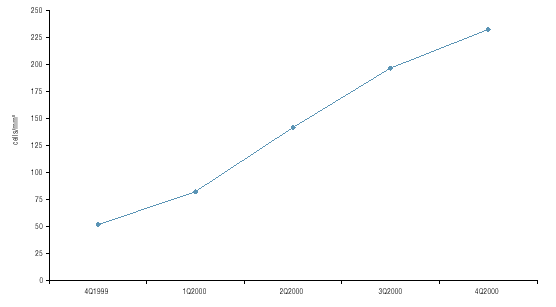
Figure 4. Mean Number of Antiretrovirals Used Prior to Initiating Kaletra Therapy
Viral Load Response Stratified by Baseline Characteristics
Plasma viral load measurements were evaluated as a function of baseline plasma HIV RNA (100,000 copies/mL, > 100,000 copies/mL), baseline CD 4 count (< 50 cells/mm 3 , 50-200 cells/mm 3 , >200 cells/mm 3 ), prior NRTI use (0-2, 3-4, >4), prior PI use (0-2, 3, 4, 5), and prior NNRTI use (0, 1, >1). Also, the use of NNRTI as a new class was evaluated. Viral load response has been defined as either a plasma HIV RNA measurement at or below 500 copies/mL or at least a 1.0 log 10 copies/mL decrease from baseline (for those patients who did not achieve a measurement at or below 500 copies/mL). Results are summarized in Figures 5-10.
Figure 5. Percent of Patients with Viral Load Nadir =500 copies/mL or =1.0 log 10 Below Baseline Stratified by Baseline HIV RNA
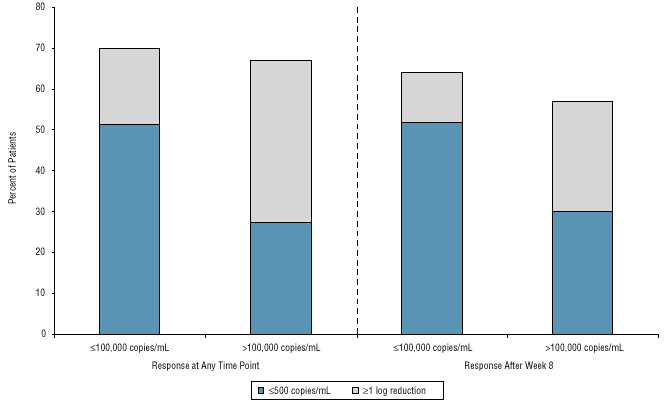
Figure 6. Percent of Patients with Viral Load Nadir =500 copies/mL or =1.0 log 10 Below Baseline Stratified by Baseline CD 4 Cell Count
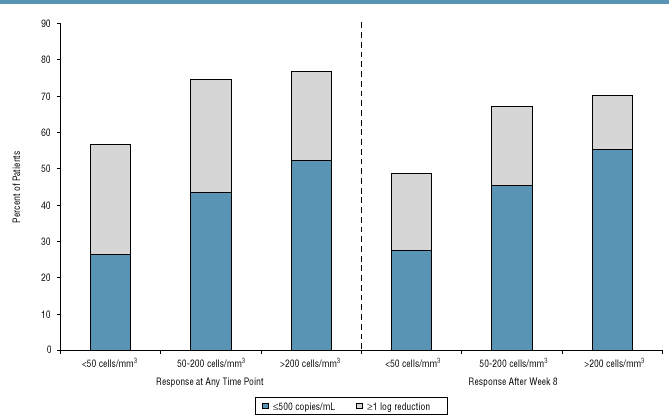
Figure 9. Percent of Patients with Viral Load Nadir =500 copies/mL or =1.0 log 10 Below Baseline Stratified by Prior NNRTI Use
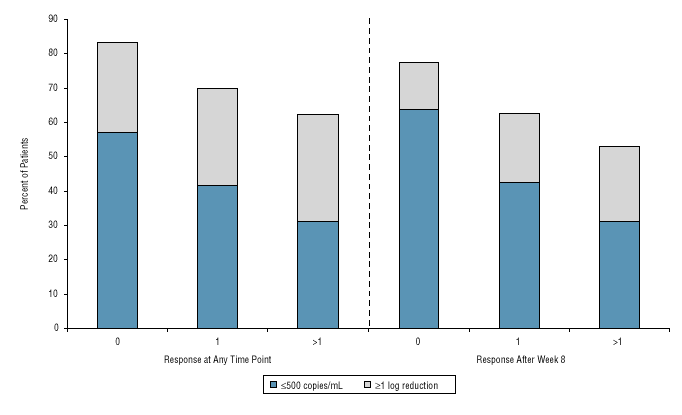
Figure 10. Percent of Patients with Viral Load Nadir =500 copies/mL or =1.0 log 10 Below Baseline Stratified by the Use of NNRTI as a New Class
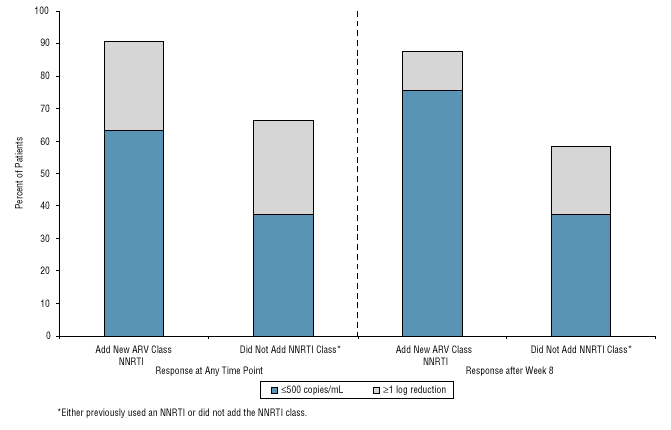
Higher baseline viral load, lower baseline CD 4 cell count, and increasing number or prior NRTIs, PIs and NNRTIs were found to be associated with a significant decrease in viral load response. Also, the use of NNRTI as a new class was found to be associated with a significant increase in viral load response. Results from a univariate logistic regression analysis are presented in Table 2.
In general, all univariate factors (or their corresponding interaction effects) were determined to be statistically significant (p<0.05) in a multiple "stepwise" logistic regression analysis. (Note: The univariate factor, use of NNRTI as a new class, was not included in this analysis due to the potential confounding with the number of prior NNRTIs used.)
SAFETY RESULTS
A total of 8,733 patients were reported to have dosed in the Kaletra EAP through December 31, 2000. The disposition of these patients is summarized in Table 3.
Of note, three countries (France, Germany and the US) implemented closeout procedures for EAP and began supplying patients with Kaletra through other means by the end of December 2000. This accounts for the large number of discontinuations in the "administrative" and "other" categories.
Only serious adverse events (SAEs) were collected in the Kaletra EAP. No specific adverse event code was reported in greater than 1% of patients. The most common SAEs reported were fever (0.72%), pancreatitis (0.58%), pneumonia (0.56%), sepsis (0.40%), anemia (0.34%), and rash (0.27%). With the exception of rash, each of these SAEs were reported more frequently in patients with screening CD 4 counts <50 cells/mm 3 when compared to patients with screening CD 4 counts =50 cells/mm 3 (p<0.001).
CONCLUSIONS
ACKNOWLEDGMENTS
Abbott Laboratories would like to acknowledge the large number of patients and physicians who have participated in the Kaletra EAP, and those groups that provided assistance with its development and implementation [advocacy groups (including the Coalition for Salvage Therapy), regulatory agencies, and Quintiles, Inc.].
REFERENCE
Beatty M, Cohen C, Coady W, Hellinger J, et al. Expanded access: the experiences of one research site. Research Practitioner, Volume 1, Number 5, 2000.


© 2001 Medical Advocates
for Social Justice
225 West Washington Street, Suite 2200, Chicago, IL 60606
Telephone (312) 419-7289 Facsimile: (312) 419-7151
Email: [email protected]